PATHOLOGIES OF THE LUNGS

Photo Credit: Pima Lung and Sleep
There's evidence to suggest that genetic factors play a role in nicotine dependence, with certain gene variants influencing how the brain responds to nicotine. Additionally, demographic factors such as low socioeconomic status, less education, and high levels of stress are more common in smokers, contributing to the difficulty in quitting. Furthermore, for many, smoking serves as a means of weight control or self-medication for mental disorders like depression.


Why is it so hard to quit?
Why you shouldn't give up
Researchers are continuously researching new pharmacological treatments to aid in the journey to quit smoking!
One promising approach is nicotine replacement therapy, which delivers nicotine through means other than smoking, such as patches or gum. While effective in reducing withdrawal symptoms, nicotine replacement alone may not address the psychological aspects of smoking addiction.
Another option is sustained-release bupropion, which acts as a nicotinic receptor antagonist and dopamine reuptake inhibitor, doubling the success rate of quitting compared to a placebo.
Finally, varenicline, a partial receptor agonist at nicotinic receptors, has shown to be more effective than both nicotine replacement and bupropion in reducing withdrawal symptoms and cravings.
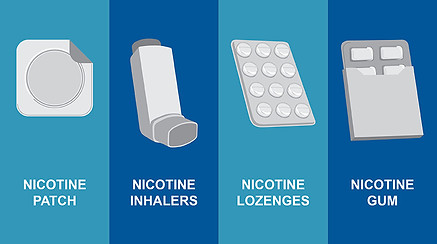
Nicotine Replacement Therapy. Photo Credit: Northern Health

Bupropion mechanism of action. Photo Credit: Psych Scene Hub
We hope this website has been informative on the dangers of smoking, but also that you are not alone! Your loved ones, researchers, and society is supportive and happy for your quitting journey!
By quitting smoking, not only can you greatly reduce the risk of lung pathologies, but smoke-free individuals can enhance their quality of life, experiencing increased energy levels, improved sense of taste and smell, and better physical fitness. Not only does quitting benefit personal health, but it also has positive ripple effects on the well-being of loved ones by minimizing exposure to secondhand smoke. Financially, kicking the habit saves considerable amounts of money in the long term. Additionally, breaking free from nicotine addiction empowers individuals, fostering a sense of accomplishment and self-control. With determination, support, and perseverance, every attempt to quit smoking brings individuals closer to a healthier, smoke-free life.
If you or a loved one has tried again and again to quit smoking, just know that you should never give up! While the power of smoking is strong you are stronger!
Don’t let your life be destroyed by yourself.
Test Your Knowledge
1. Which demographic factors are commonly associated with smokers, making quitting more challenging?
a) High income and advanced education
b) Low socioeconomic status, less education, and high levels of stress
c) Teenagers with supportive family environments
d) Middle-aged adults with stable jobs
2. Which therapy delivers nicotine through means other than smoking, such as patches or gum?
a) Acupuncture therapy
b) Cognitive-behavioral therapy
c) Hypnosis therapy
d) Nicotine replacement therapy
3. What is the primary function of sustained-release bupropion in smoking cessation?
a) It increases the craving for nicotine.
b) It acts as a stimulant to replace nicotine.
c) It doubles the success rate of quitting compared to a placebo.
d) It reduces withdrawal symptoms and cravings by acting as a nicotinic receptor antagonist and dopamine reuptake inhibitor.
4. Among the listed therapies, which one has shown to be more effective in reducing withdrawal symptoms and cravings compared to nicotine replacement therapy and sustained-release bupropion?
a) Cognitive-behavioral therapy
b) Hypnosis therapy
c) Acupuncture therapy
d) Varenicline, a partial receptor agonist at nicotinic receptors